 English
 Indonesia

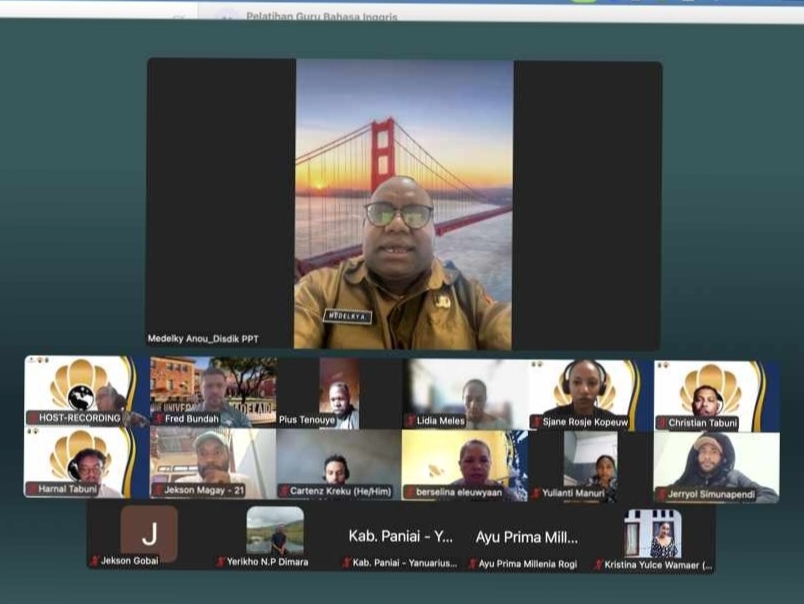
Official Opening of the Online Training of Trainers (ToT) for English Teachers via Zoom for Three Regencies: Nabire, Paniai, and Mimika
NABIRE, May 5, 2026 — A simple yet deeply meaningful sentence echoed across Zoom screens that morning. "Local problem Best Solved By local people." These words were firmly delivered by Mr. Meldeky Anouw, representing the Education Office of Central Papua Province, as he officially opened the Training of Trainers (ToT) program for English teachers recruited by the Mutiara Hitam Papua Foundation.
The training was officially opened on Tuesday, May 5, 2026, and will run for three consecutive days online via Zoom Meeting. The program is part of a collaboration between the Education Office of Central Papua Province and the Mutiara Hitam Papua Foundation to support English-language learning across three regencies: Nabire Regency, Paniai Regency, and Mimika Regency.
Although the participants were spread across various regions — from Nabire and Paniai to Mimika — their enthusiasm and energy radiated through every lit-up screen. The online format via Zoom was chosen as a smart solution to reach teachers in three regencies simultaneously, without requiring the long and often difficult journeys that are common across the land of Papua.
For Meldeky Anouw, the phrase "local problem best solved by local people" is more than a slogan. It is a guiding principle of his life, and the direction of the educational policy he champions: that the challenges facing Papua should be addressed by the hands of Papuans themselves — by those who understand the heartbeat of their own land.
Gratitude and Appreciation for the Sons and Daughters of Papua
Opening his remarks before the boxes of participants filling the Zoom screen, Meldeky Anouw expressed his gratitude and thanks for the partnership that has been forged between the Education Office of Central Papua Province and the Mutiara Hitam Papua Foundation since last year. He extended special appreciation because the foundation is fully managed by native sons and daughters of Papua — something he believes deserves to be celebrated and supported.
"This foundation is run by Papuan children themselves. This is exactly what we hope for — Papuans building Papua," he said with conviction, his voice resonating through the speakers of participants in Nabire, Paniai, and Mimika.
English: A Priority for Central Papua's Education
During the virtual ToT opening, Meldeky Anouw emphasized that English has become one of the priority programs of the Central Papua Provincial Education Office. The program is not merely a short-term response, but rather a form of synchronization and acceleration aligned with the policy of the Ministry of Primary and Secondary Education (Kemendikdasmen), which will introduce an English-language curriculum at the elementary school level beginning in 2027.
Central Papua, under Meldeky Anouw's direction, has chosen not to wait. Preparations are being made far in advance, with a clear and ambitious goal: that elementary, junior high, and senior high school students in Central Papua will have a strong foundation in English and be able to compete for prestigious international scholarships such as the Garuda Scholarship, Australia Awards Scholarship (AAS), LPDP, Chevening, and Fulbright.
"We want the children of Central Papua to have the same opportunities as children anywhere in the world. English is one of the keys," he affirmed.
Meet Meldeky Anouw: A Son of Beoga Who Reached America and Chose to Return
Behind his firmness and his vision for Central Papua's education, who is the man who appeared on the Zoom screens of participants that morning? To understand why he fights so passionately for Papuan children's mastery of English, we need to trace his extraordinary life journey.
Born in a Remote Village, Dreaming of the World
Meldeky Anouw — affectionately known as Deky — was born and raised in Beoga District, Puncak Regency, Central Papua. It is a remote mountainous area, geographically challenging, with limited access and rugged terrain. His background was, in many ways, much like that of most Papuan children: a life shaped by limited access and simplicity.
But one thing set his story apart: his parents, especially his father, had long understood that education was the path to a better future. "My father was deeply supportive of education. The moment he came home from the office, he would teach us how to read, write, and count," Deky has recalled in various interviews about his father.
In the middle of his undergraduate studies, Deky lost his beloved father — a heavy blow that shook him, but did not break his resolve. With the support of his family, he kept moving forward.
Nine Months to Conquer English
Before becoming an official at the Education Office, Deky was a chemistry teacher at a private school. His love for education, especially in the STEM fields, drove him to keep learning and growing. He realized that to make a wider impact for Papuan children, he needed to elevate his academic capacity to a higher level.
He learned about the LPDP Scholarship (the Indonesia Endowment Fund for Education, under the Ministry of Finance) through Facebook networks and announcements from BPSDM Papua. He applied — but the road to that scholarship was far from easy.
One of his greatest obstacles was English. The IELTS score required felt like a towering wall. Deky entered a language enrichment program for six months, but his score still fell short. Many people might have given up at that point — but Deky chose to persevere. He extended the enrichment program by another three months, until he finally reached the required score.
A total of nine months of struggle to conquer English, rising and falling in pursuit of every score. "The most important thing is that I never gave up," is the principle he held onto then, and the one he now passes on to the younger generation of Papua.
From Beoga to Arizona
That struggle bore fruit. Deky was admitted to Arizona State University in the United States, one of the world's renowned campuses. He had originally applied for pure Chemistry, but with several pathways closed by the pandemic, he eventually pursued a master's degree in Hydrothermal Organic Geochemistry.
In America, a new world opened before him. Laboratories with advanced equipment, an academic culture that championed the freedom to ask questions, and a professor who once told him, "There is no stupid question" — a sentence he still remembers vividly. Deky even served as a teaching assistant in a high-tech laboratory.
Refusing America, Choosing Papua
After graduating, career opportunities in the United States were wide open for Deky. He nearly secured a position as a science teacher in New Jersey, and considered several other overseas job offers.
But one night, while reviewing digital lab reports as a teaching assistant, Deky paused to reflect. The modern facilities he witnessed every day stood in stark contrast to the conditions of schools back home in Papua — many lacked teachers, had limited laboratories, and some had even shut down due to conflict.
That awareness changed everything. Deky chose to come home.
Not for luxury, not for a degree to display, but to become part of the development of his homeland. He now serves as Acting Head of the Education Funding Section at the Central Papua Provincial Education Office, managing hundreds — even thousands — of scholarships for Papuan children: from the Papuan Outstanding Student Scholarship and university partnerships, to more than five thousand students receiving educational assistance.
The circle is now complete: from a scholarship recipient, he has become the manager of scholarships for the next generation.
Going Directly to Remote Areas
Deky's work is not confined to a desk. He often boards small pioneer aircraft, pushing through unpredictable weather, landing on grass airstrips in the middle of mountains, reaching schools in conflict-affected areas such as Puncak, Intan Jaya, and Puncak Jaya.
"I have seen schools in conflict areas, schools that were burned down, schools without teachers," he has recounted on other occasions. "My heart broke seeing children climbing up and down mountains, walking barefoot, to schools that weren't even theirs."
This is the figure who appeared on the Zoom screens of the ToT participants that morning. Not merely an official reading a formal speech behind a camera — but a son of Papua who once fought for nine months with English, who reached Arizona, and who chose to return home to build the land of his ancestors.
A Message to the Trainers: You Are the Bridge to Papuan Children's Dreams
Understanding this background is what gives Meldeky Anouw's remarks such weight, even when delivered through a virtual room. When he speaks about the importance of English for Papuan children, it is not theory — it is lived experience. When he names LPDP, AAS, Chevening, or Fulbright as targets for the children of Central Papua, he speaks from the experience of an awardee who has walked that very path.
Before the ToT participants connecting from various points across Central Papua, Meldeky Anouw delivered a message that ignited the spirit. He hopes that this training opportunity will be used to its fullest — not only to gain experience and enrich portfolios, but also to grow into reliable English trainers for Papuan children in Nabire, Paniai, and Mimika.
"You are the spearheads. The children of Papua in Nabire, Paniai, and Mimika are waiting for you — the best teachers from their own land," he conveyed with conviction, through the Zoom connection that brought teachers from three regencies together in one digital space.
The message resonated even more powerfully because it came from someone who had once stood in the same place — a Papuan who had also wrestled with English, and who now stands as living proof that the dream is possible.
Online Training of Trainers: Three Days to Prepare the Spearheads Through the Screen
The ToT activities, opened on May 5, 2026, will run for three consecutive days, until May 7, 2026, entirely via Zoom Meeting. Throughout the three full days, the teachers recruited by the Mutiara Hitam Papua Foundation will be equipped with training materials, contextual learning modules tailored to local Papuan conditions, and effective teaching strategies before being deployed to teach students in Nabire, Paniai, and Mimika.
Holding the program online is an apt solution amid the geographic challenges of Central Papua. With a virtual format, teachers do not need to leave their respective regions, yet can still fully and interactively participate. The training sessions are designed to remain dynamic through breakout rooms, small group discussions, Q&A sessions, and teaching simulations — all conducted online, but with quality on par with face-to-face training.
The selection of these three regencies was made with strategic considerations — reaching areas with a real need for stronger English-language instruction, while serving as a starting point before the program expands to other regencies in Central Papua.
Meldeky Anouw also outlined plans for the future, in which English teacher training is expected to reach all eight regencies of Central Papua with an approach that breaks from convention: the training will be conducted directly in each regency, rather than centralized in Nabire or Timika. According to him, this approach will be closer to the teachers themselves, more contextual, and more accessible to those who have long struggled to attend centralized trainings.
In the second semester or second quarter following the budget revision, Meldeky Anouw hopes that the cooperation with the Mutiara Hitam Papua Foundation can continue to bring this expansion to life.
Opening the Door to the Future Through the Hands of Papua's Own Children
With the official opening of the online Training of Trainers on May 5, 2026, Central Papua takes another step closer to its grand vision: preparing a young generation that is fluent in English, confident on the global stage, yet still rooted firmly in the soil of their ancestors. Technology has become the bridge that brings together change-makers from three regencies — a testament that distance is no longer an obstacle when determination has been ignited.
The figure of Meldeky Anouw — a son of Beoga who fought for nine months to conquer English, who reached Arizona, who turned down America, and who chose to return for Papua — stands as living proof that this grand vision can be realized. And now, for the next three days, through Zoom screens lit up from Nabire to Paniai to Mimika, the same dream is being passed on to thousands of Papuan children through the hands of the ToT participating teachers.
"Local problem best solved by local people." The phrase is no longer merely spoken — it is being lived out by a man who embodies it, transcending space and distance through technology. From Beoga to Arizona, from Arizona back to Nabire, from Nabire spreading to Paniai and Mimika through the internet, from Zoom rooms into the classrooms that await — the children of Papua are being prepared by their own brothers and sisters.
And therein lies the beauty of it all: Papua is being built by Papua, with the hands, the hearts, and the vision of its own children — unbounded by distance or by mountains.

Add New Comment