 English
 Indonesia
NABIRE — Imagine an English class where students learn to
bargain over vegetable prices at the market, describe a bird of paradise
dancing in the forest, or retell the stories of their ancestors in a global
language. English no longer feels foreign, because it speaks of their own land,
gardens, and culture.
This is the spirit now brought to life by the Papua Teacher
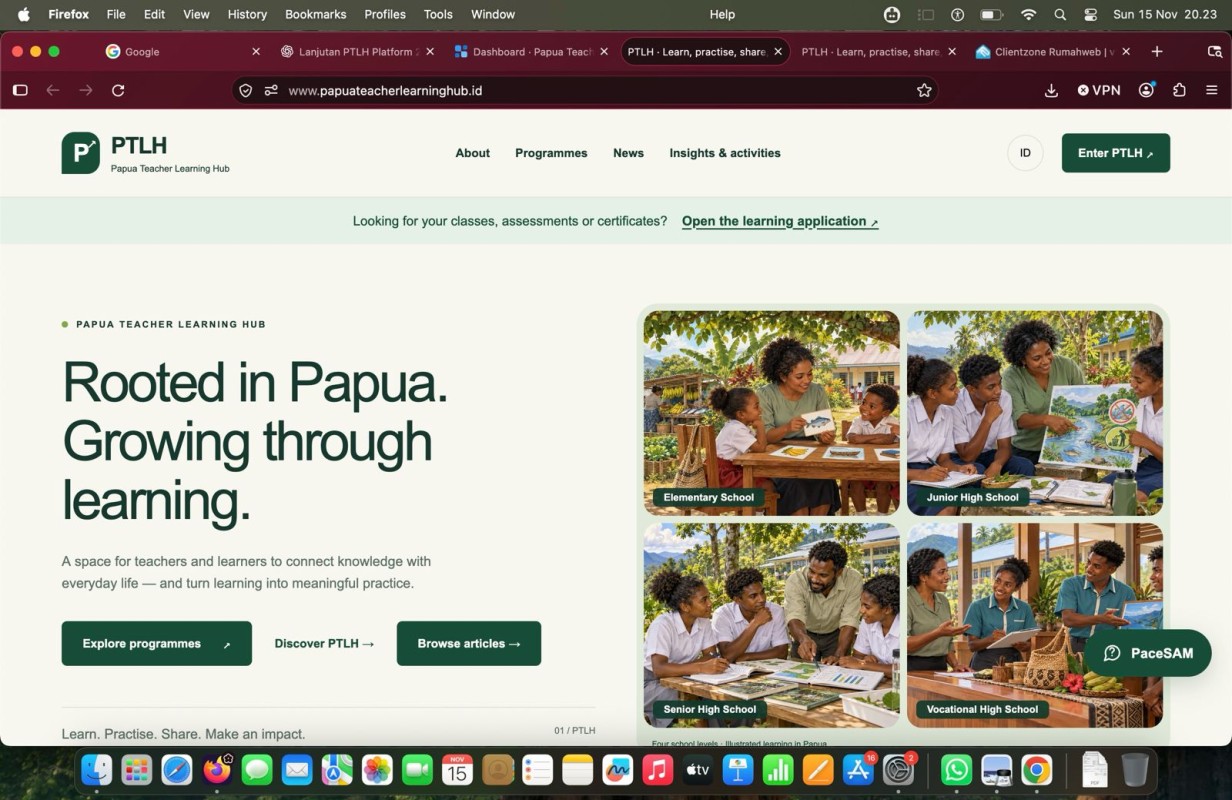
Learning Hub (PTLH), a learning platform that has been officially launched and
is open to teachers and learners across the Land of Papua. PTLH serves as a
space that connects English learning with the everyday life of the community:
bustling markets, family gardens, unique wildlife, and the rich cultural
heritage of Papua.
PTLH is currently being used in English teacher training in
Central Papua Province, which is taking place in three regencies: Nabire
Regency, Paniai Regency, and Mimika Regency. To support the training, the
foundation has prepared contextual training modules that can be accessed
directly through the platform. Through PTLH, participating teachers attend
classes, study the modules, complete assessments, and earn certificates.
Born
from the Commitment of Yayasan Mutiara Hitam Papua
PTLH is a concrete initiative of Yayasan Mutiara Hitam Papua
(YMHP) through its Inovasi Tutor program. As a partner of the Central Papua
Provincial Office of Education and Culture, YMHP is committed to supporting the
vision and mission of the Governor of Central Papua in education, particularly
in improving the quality of teachers and learning in the Land of Papua.
For YMHP, progress in education begins with teachers.
Teachers are the ones who stand in front of the classroom every day, greet the
children, and plant dreams about the future. When a teacher keeps growing,
hundreds of children in that classroom grow along with them. That is why YMHP
has chosen to invest in strengthening teachers' capacity through a platform
that is accessible, relevant, and sustainable.
A Papuan
on the International Stage
The platform was developed by YMHP tutor Samuel Aleksander
Mandowen, a Mathematics lecturer at Cenderawasih University (Uncen), Jayapura.
Samuel was awarded an Australia Awards Scholarship to pursue
a Master of Information Technology at Queensland University of Technology
(QUT), Australia. He is now a doctoral candidate in Russia. His background in
information technology has been an important foundation for building a PTLH
system that teachers from many different regions can access.
His journey is proof that the children of Papua can stand as
equals on the world stage. That knowledge and experience are now being
dedicated to the teachers of Papua through PTLH.
Learning
from What Is Closest
For a long time, many English teaching materials have used
examples far removed from the daily lives of students in Papua. Students are
asked to talk about snow, subways, or food they have never seen. As a result,
lessons feel distant and difficult to understand.
PTLH is here to change that through Contextual Teaching and
Learning (CTL), an approach that links learning materials to real situations in
students' lives. Through PTLH, educators are invited to experience,
deconstruct, and create meaningful learning for students in primary schools
(SD), junior high schools (SMP), senior high schools (SMA), and vocational high
schools (SMK).
In practice, vocabulary can be taught through buying and
selling at the market, descriptive texts through Papua's endemic wildlife, and
storytelling skills through local traditions and culture. Students do not
merely memorize words; they also learn to use language to tell the story of
their own world with pride.
This approach also positions teachers as designers of
learning, not merely deliverers of textbook content. Teachers are encouraged to
observe their school surroundings, find stories that are close to their
students, and turn them into enjoyable learning activities. In this way, every
classroom in Papua, from the cities to the villages, can have English lessons
that are distinctive and meaningful.
The surrounding environment is no longer just a backdrop, but
a living learning resource. Markets, gardens, forests, and traditional houses
can become open-air classrooms that invite students to think, speak, and create
in a global language.
Reaching
Teachers in Remote Areas
The materials prepared by the foundation are expected to
provide valuable access for teachers, especially those serving in outlying
areas and the highlands of Central Papua. Until now, long distances and
difficult terrain have often prevented teachers in these areas from attending
training and obtaining quality teaching materials.
Now, PTLH modules can be accessed via the internet. A number
of schools in Central Papua are already connected to the internet through
Starlink devices. This connectivity brings real benefits to teachers in the
interior and in 3T areas (frontier, remote, and disadvantaged regions) of
Central Papua, as they can learn, attend classes, and develop their teaching
skills without having to travel long distances to the city.
Two
Doors to the Learning Space
PTLH offers two services that can be used according to need:
•
A
public website at www.papuateacherlearninghub.id, featuring teaching insights
and articles that anyone can read.
•
A
learning platform at app.papuateacherlearninghub.id, for registered
participants to attend classes, complete assessments, and earn certificates.
Time for
Papuan Teachers to Step Forward
"Let us learn, practice, share, and make a real impact
in our classrooms," is PTLH's invitation to educators.
PTLH is expected to become a shared home for Papuan teachers
to collaborate, support one another, and improve the quality of English
learning without being uprooted from their local identity and wisdom.
From Nabire, Paniai, and Mimika to all of the Land of Papua,
great change always begins with one classroom and one teacher who is willing to
keep learning.
For more
information:
Public website: https://www.papuateacherlearninghub.id/
Learning platform: https://app.papuateacherlearninghub.id/
Add New Comment