 English
 Indonesia

The morning is still misty when a child in the mountains of Central Papua
ties the laces of his fraying shoes. Before him stretches a slippery footpath
that winds down, then climbs again. He walks for hours, sometimes crossing
rivers, sometimes cutting through forest, for one simple reason: to sit in a
classroom and learn. Elsewhere, on the coast of Nabire, a fisherman's child
gazes at the sea before setting off for school. Her father has been out on the
water since dawn, while her mother counts yesterday's earnings from selling
fish, setting aside a little for rice and a little more for school. Too often,
what remains is not enough.
This is the face of education for many families in Central Papua. From
the valleys of Paniai and Deiyai and the slopes of Intan Jaya to the villages
of Mimika, children carry dreams as big as those of children in any city. Some
want to become teachers so their younger siblings can learn to read. Some want
to become doctors because they have watched their families fall ill without
help. Others dream of becoming engineers, pilots, or leaders who will build up
their own villages.
Yet for years, many of those dreams withered before they could grow. It
was not because the children were lazy or lacked ability. They dropped out
because school fees, committee fees, uniforms, and other charges weighed too
heavily on families who live off their gardens, sago, and the sea. Many parents
faced heartbreaking choices: whether to send the eldest child or the youngest
to school, whether to buy books or buy food. Some children had to leave the
classroom to help in the gardens, and some kept their last report card in a
noken bag as a keepsake of ambitions they could not pursue.
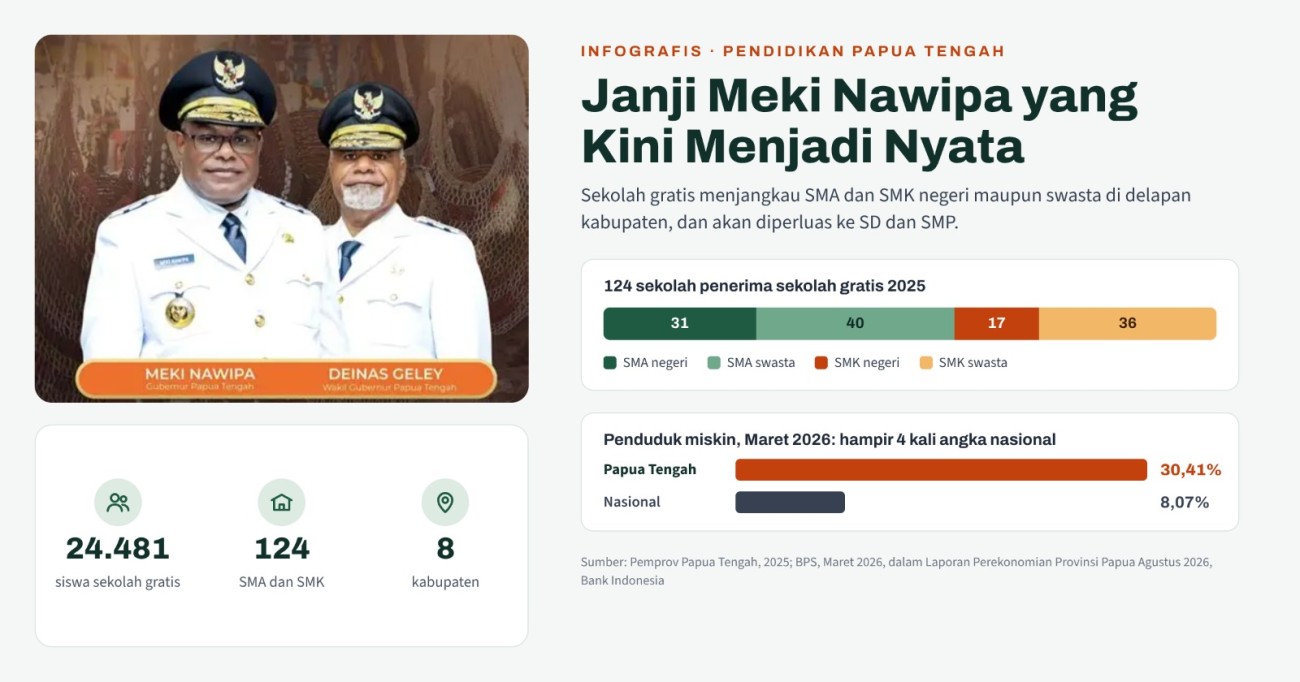
The numbers tell the same story. In March 2026, 30.41 percent of Central
Papua's population lived in poverty, almost four times the national rate of
8.07 percent. Around three quarters of the province's workforce still depends
on agriculture. For poor families, even the smallest school fee can become a
wall between a child and their future.
It was against this backdrop that Central Papua Governor Meki Fritz
Nawipa took a step that addresses the root of the problem. He made free
education a priority of his administration. He declared that every Papuan
child, whether living beyond the mountains, on the hillsides, along the coast,
or on the islands, deserves an education, and that the provincial government
will cover the cost. The words are simple, but for a mother in a village they
mean a great deal. She no longer has to delay her child's schooling until
harvest season. A father no longer has to bow his head in shame because he
cannot pay committee fees. And a child can once again hold their head high,
grip their books, and believe that their dream still has a path forward.
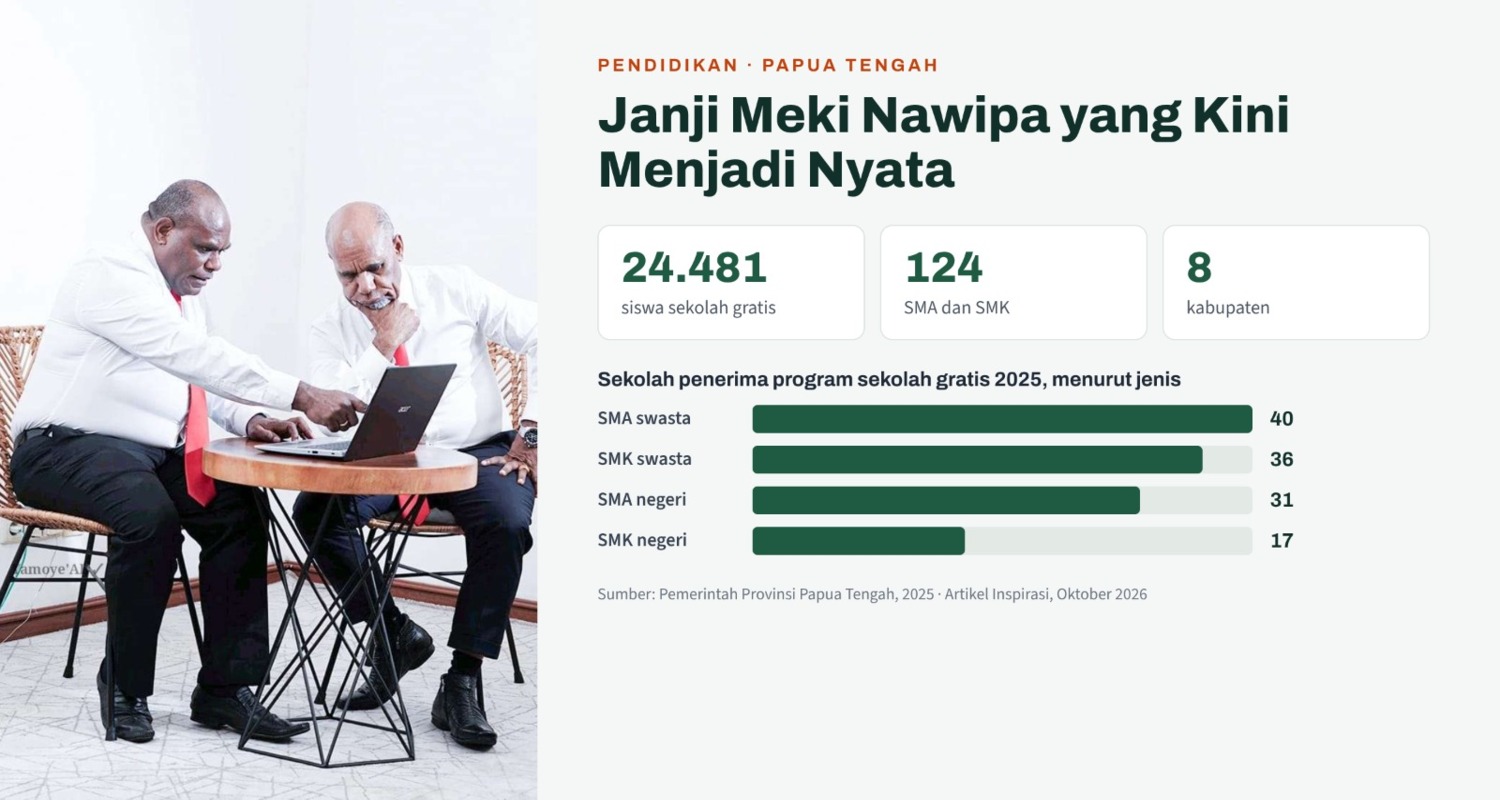
That promise did not stay on the podium. In 2025, Central Papua's free
school program officially began for 24,481 senior high school and vocational
school students in 124 schools across eight regencies. These include 31 public
senior high schools, 40 private senior high schools, 17 public vocational
schools, and 36 private vocational schools. The program does not target public
schools alone. Private schools, including those run by church foundations and
institutions that have long pioneered education in the Land of Papua, are
included as well. For parents, the impact is immediate: money once spent on
school fees can now go toward the family's basic needs. For children, one major
reason to drop out of school has disappeared.
This commitment has been set out in a series of official policies funded
by the Central Papua provincial budget (APBD). On 3 September 2025, the
Governor issued Governor's Decree No. 226 of 2025 designating recipients of
education cost assistance for university students from Central Papua. A month
later, on 3 October 2025, Governor's Decree No. 259 of 2025 on the
Implementation of the Free School Program was issued, complete with a list of
recipient schools and unit costs. Three days later, Governor's Decree No. 261
of 2025 designated schools to receive smart boards to support digital learning.
On 17 November 2025, the Governor formed a Free School Program Working Team
through Governor's Decree No. 284 of 2025, effective retroactively from July
2025, to oversee outreach and implementation. At the regulatory level,
Governor's Regulation No. 14 of 2025 updated the rules on education cost
assistance so that tuition, committee fees, and other study costs can be
covered through the Central Papua Smart Card (Kartu Papua Tengah Cerdas), with
priority for Indigenous Papuans. Governor's Regulation No. 23 of 2025 ensured
that spending on education, scholarships, and education assistance could still
be paid before the 2026 budget was enacted, so that education services would
not stop merely because of the budget process. All of this was then underpinned
by Regional Regulation No. 1 of 2026 on the 2026 Provincial Budget, and
strengthened by Regional Regulation No. 9 of 2026 on Empowering Pioneer
Education Institutions and Private Education Institutions, a tribute to the
foundations that were educating Papuan children long before the province was
established.
On the budget side, provincial planning documents list an indicative allocation of around Rp491.56 billion for education affairs, plus around Rp41.72 billion for cultural affairs. The final figures in the enacted budget may differ. Overall, Central Papua's 2025 budget had a spending ceiling of Rp4.812 trillion, of which Rp3.781 trillion was realized. When presenting the 2025 budget accountability report to the Central Papua Provincial Legislature on 31 July 2026, Governor Nawipa stressed that every rupiah of the budget must be directed toward accelerating development, including education services.
Governor Nawipa also understands that abolishing school fees alone is not
enough. Hungry children struggle to learn, children in conflict-prone areas
struggle to attend school in peace, and high school graduates need a path to
further education. That is why free schooling is complemented by Full-Day
Schools with free lunches to reduce dropout rates, as well as the construction
of school dormitories in conflict-prone areas. The provincial government also
provides higher education scholarships for both Indigenous and non-Indigenous
Papuan students studying in Timika and Nabire. A total of 120 students from
Central Papua have received provincial scholarships to study at Sekolah GenIUS
in Tangerang. Looking ahead, the Governor plans to establish a Vocational Training
Center so that young people are ready to become skilled workers and
entrepreneurs capable of managing their region's natural resources.
Free schooling for senior high and vocational schools is only the first
step. Governor Nawipa has stated that in 2026 the program will expand to
elementary and junior high schools, with the goal of making all levels of
education in Central Papua free within three years. He describes the policy as
an effort to raise Central Papua's Human Development Index, a long-term
investment whose results will be felt when the generation now sitting in
classrooms begins to lead its own region.
Government policy becomes more powerful when civil society embraces it.
One such partner is Yayasan Mutiara Hitam Papua (Black Pearl Papua Foundation),
now based on Jalan Ds. Yan Mamoribo, Sanoba, Siriwini, Nabire. Its roots go
back to 2008, when Black Pearl Network Australia began working with the Synod
of the Evangelical Christian Church in the Land of Papua (GKI di Tanah Papua).
In 2016 the first English class opened in the West Sarmi Classis of GKI, and in
2020 the foundation was formally established. Today, the Black Pearl English
Course operates in 14 centers across the Land of Papua, two of them in Nabire.
On 7 May 2025, the foundation and Ross Gobby of Black Pearl Network Australia
met with the Governor and the Regional Secretary of Central Papua. They
discussed developing intermediate and advanced English classes, pilot programs
in several schools, training English teachers to international standards, and
making IELTS and TOEFL tests more affordable for the children of Central Papua.
The Governor welcomed the initiative and expressed his support, as it aligns
with his vision of building a smart and competitive Central Papua. The
foundation also opens pathways to scholarships through information sessions on
the LPDP scholarship together with the GKI Nabire Classis. Each year, it sends
two young Indigenous Papuans to study for three months in Perth, Australia, and
it educates communities in Nabire on balanced nutrition using local foods to
prevent stunting. The provincial government opens the school doors wide, while
foundations like this one equip children with language, networks, and the
courage to step onto the world stage.
Free education in Central Papua is proof that public policy can directly
serve ordinary people. Governor Meki Nawipa did not stop at making promises. He
delivered a program that can be measured: tens of thousands of students, more
than a hundred schools, and a clear plan to reach every level of education. Of
course, the road ahead is still long. Teacher quality, school facilities in
remote areas, accurate disbursement of funds, and budget sustainability must
continue to be safeguarded. The program's success is a shared responsibility:
parents who encourage their children to go to school, teachers who teach
wholeheartedly, churches and customary leaders who set an example, foundations
that broaden children's horizons, and communities that help keep watch.
If everyone works hand in hand, the dreams of children in the mountains,
valleys, and coasts of Central Papua will no longer stop at the school door. It
is in those classrooms that Central Papua's golden generation is being shaped.
The promise made to the children beyond the mountains and on the shores has now
become reality, and our shared task is to make sure its flame never goes out.

Add New Comment