 English
 Indonesia

Mutiara Hitam Papua Foundation Trains 90 English Teachers in Central Papua
Part of a provincial government program to train 150 teachers across five regencies to support Governor Meki Fritz Nawipa’s education transformation agenda
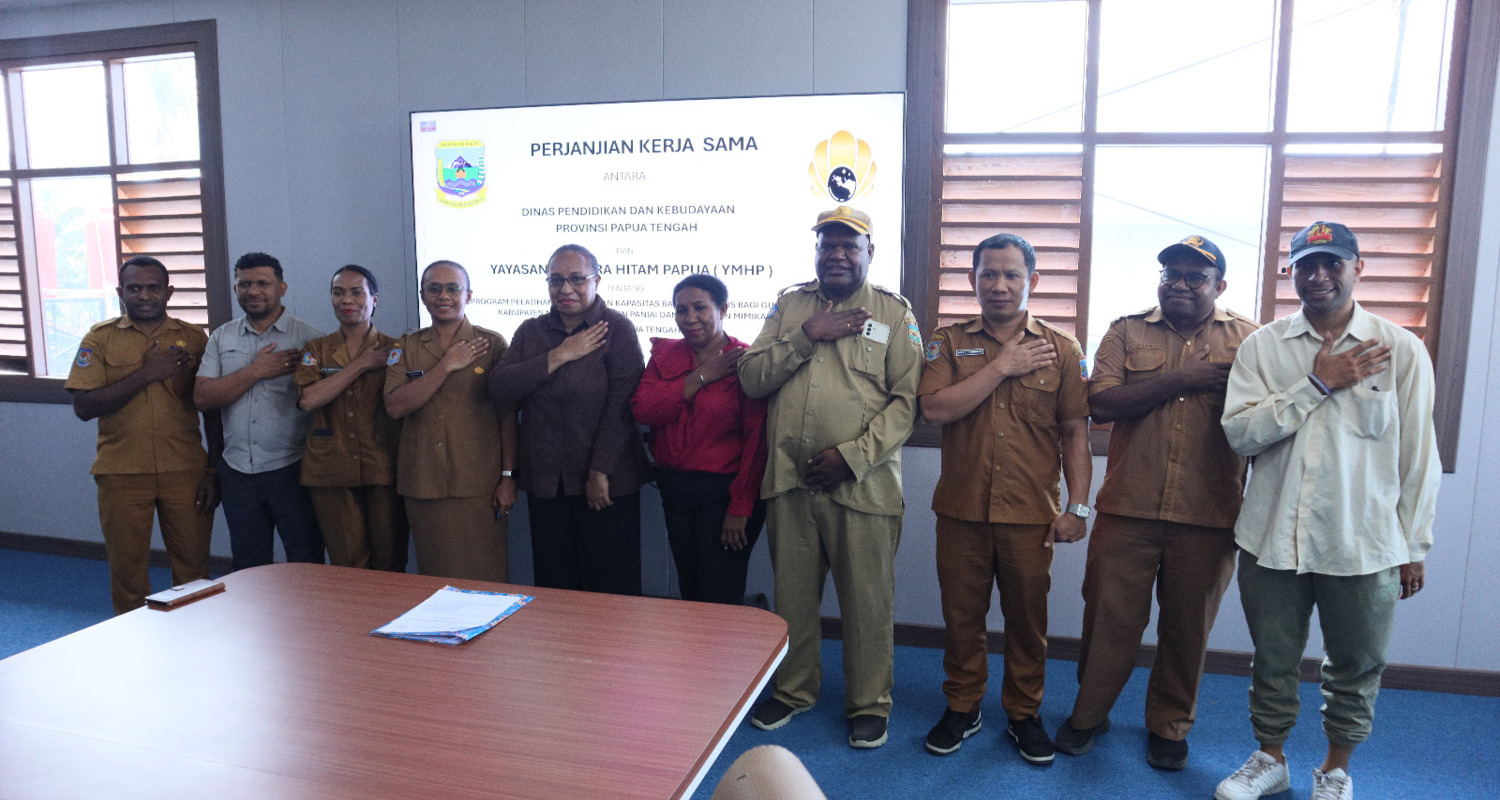
NABIRE – The Mutiara Hitam Papua Foundation trained 90 English teachers in Paniai Regency, Mimika Regency, and parts of Nabire. The training was the largest part of the Central Papua Provincial Government’s program, which involved a total of 150 teachers from five regencies and was conducted for 66 days.
The program was carried out by the Central Papua Education and Culture Office (Disdikbud) together with two partners, namely the Mutiara Hitam Papua Foundation and the Syena Ahor Papua Foundation (SAPA). The partnership was established through a Cooperation Agreement (PKS) before the training began.
Emphasizing Accountability in the Field
The Acting Head of the Central Papua Education and Culture Office, Nurhaidah, S.E., emphasized the importance of accountability from both foundations during the implementation of the program. According to her, accountability must be maintained from the field training process to the reporting stage.
Nurhaidah hopes that this training will provide a real impact, not only for teachers but also directly in classrooms.
“This training is expected to provide direct benefits for English teachers, which will certainly have a direct impact on students in the classroom. This is our shared hope,” she said.
The Largest Area Coverage for Mutiara Hitam
The Head of the Data and Information Section of the Central Papua Education and Culture Office, Yuly Yasmin Tecuari, said that the Mutiara Hitam Papua Foundation was trusted to handle the area with the widest distribution of participants.
“The Mutiara Hitam Papua Foundation handles Paniai, Mimika, and parts of Nabire,” Yuly said.
Meanwhile, SAPA trains the remaining 60 teachers, consisting of elementary school teachers in Nabire, as well as 17 teachers in Dogiyai and 19 teachers in Deiyai.
According to Yuly, both foundations were selected because they have experience in developing English language learning in Papua. This experience is considered important considering that geographical conditions, security situations, and limited teaching personnel remain challenges in reaching children in remote areas.
“This is a challenge, and we must find the best solutions to advance the children of Central Papua,” she said.
She explained that this semester’s program focuses on teachers because they play a direct role in transferring English language skills to students in schools. The Central Papua Education and Culture Office aims for this program to eventually reach all eight regencies in Central Papua. For the three regencies that have not yet been included this year, the office will first conduct a survey on teacher needs and regional conditions.
Changing the Previous Approach
The Head of the Education Data and Services Division of the Central Papua Education and Culture Office, Yulianus Kuayo, stated that strengthening English language skills is one of the foundations of education transformation in the province.
According to Yulianus, previously the opportunity to learn English was only enjoyed by a small number of students who were selected and funded to attend courses outside Papua. Through partnerships with local foundations, the provincial government is now bringing the program to Central Papua so that it can be accessed by more children.
“One of the education transformations we are carrying out is preparing children from Central Papua to become competitive. Previously, some children were selected and funded to take courses outside Papua. Now, we are changing that concept,” he said.
The program is designed in stages, starting from fourth, fifth, and sixth-grade elementary school students, then continuing to junior high school, senior high school, and vocational school levels. Students who participated in courses in previous years will continue their learning at the next level.
The Central Papua Education and Culture Office recorded that 4,400 students participated in this program in 2025 and 2,294 students in 2026.
English proficiency has also become one of the requirements for admission to Mepago Senior High School.
“If people later ask where the children who can speak English come from, we have prepared them from the foundation level, starting from elementary school, junior high school, senior high school, and vocational school,” Yulianus said.
He added that amid the program of sending students outside Nabire, the government wants to ensure that every child has equal opportunities. Foreign language skills are considered an important foundation for continuing education and competing in the workforce.
“That is the transformation. English is one of the foundations that the Governor wants to establish. All children have the right to access foreign languages from the basic level, and teachers must also be trained,” he said.
In Line with the Golden Central Papua Vision
This program is in line with the Golden Central Papua vision promoted by Meki Nawipa and Deputy Governor Deinas Geley. During the 2024 gubernatorial election debate, Meki explained that Golden Central Papua represents services in all aspects of life based on the fifth principle of Pancasila, namely social justice for all Indonesian people.
Attention to teachers was also conveyed during the campaign period. At that time, Meki emphasized that the existence of schools would have no meaning without teachers and promised to recruit local education graduates to teach in conflict-affected areas with equivalent salaries and incentives.

Add New Comment